
High-Impact Perimeter Defense: Commercial Galvanized W-Beam Installation for Main Event in Woodbury, MN
If you’ve got kids—or if you’ve ever been the designated driver for a weekend birthday party—you know that the parking lot of a family entertainment center is its own special brand of chaotic. Minivans are backing out, excited kids are hopping off curbs, and delivery trucks are trying to squeeze past it all. When the developers behind the massive new Main Event on Bielenberg Drive in Woodbury, MN, were drawing up the site, vehicular safety wasn’t an afterthought; it was priority number one. Because the property features elevated, multi-tiered access roads sitting right against the high-speed Interstate 94 corridor, they needed a barrier that didn’t just mark the property line—they needed something that would physically catch a 5,000-pound SUV if a driver accidentally hit the gas instead of the brake. They called Twin Cities Fence to install a Commercial Galvanized Guardrail for their Woodbury Property. Here is a look at our recently wrapped up highway-grade Galvanized W-Beam Guardrails installed across the site, custom-bending the steel to hug the property’s unique landscape.
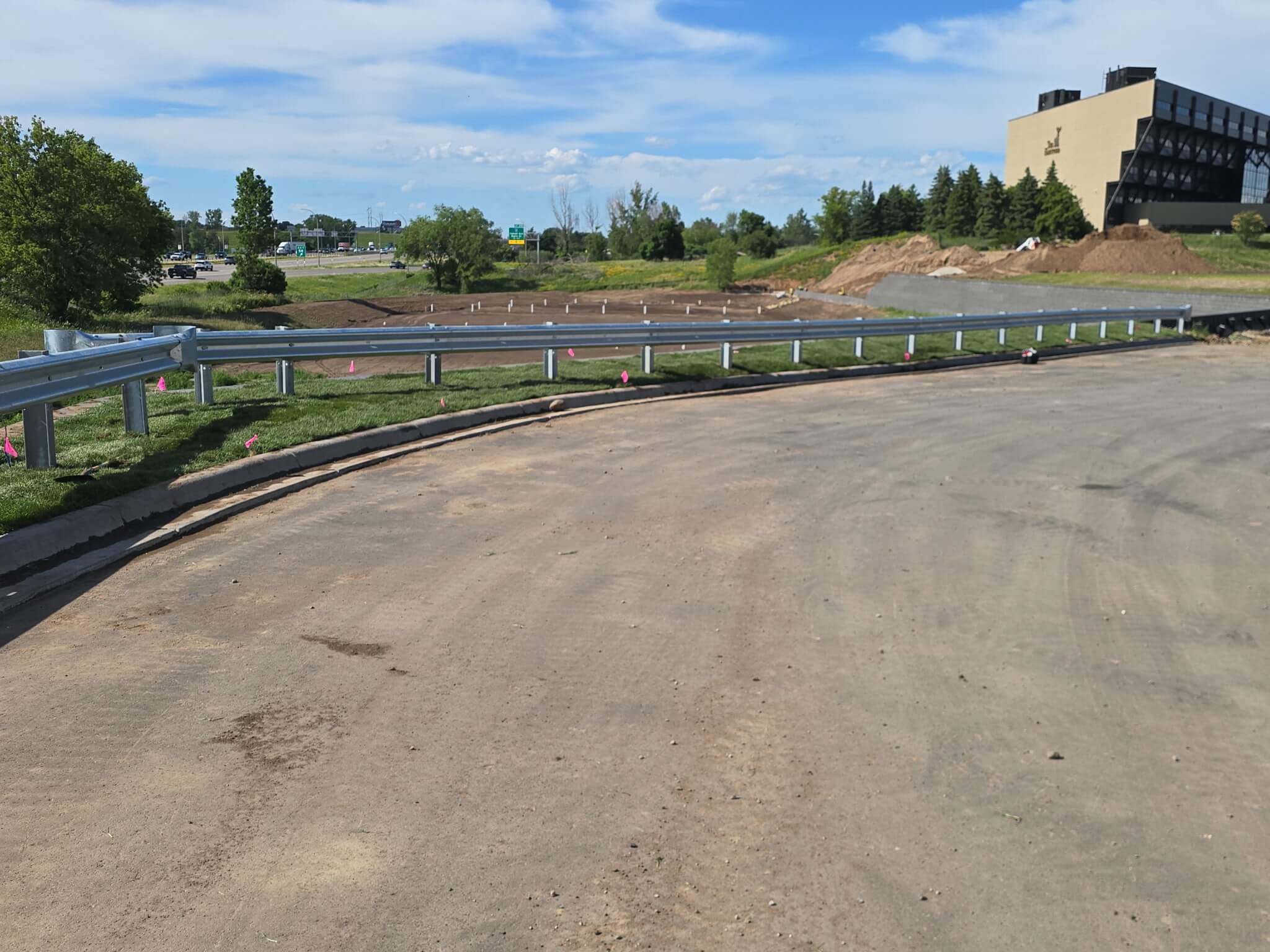
Why “W-Beam” Steel? (Explaining the Physics Simply)
To most people driving by, a guardrail is just a silver wall. But to a fencing engineer, it’s actually a carefully calibrated shock absorber. For a high-traffic site like Main Event, standard 12-gauge roll-formed W-beams were the only sensible choice, and it comes down to three basic design tricks:
- The “Baseball Glove” Effect: Look at the side profile of a guardrail; it’s shaped like a ‘W’. That groove sits at the exact average height of a car bumper. When a car hits it, the ‘W’ acts like a catcher’s mitt, trapping the bumper so the car doesn’t slide underneath the rail or ramp up over the top of it.
- It Bends, So You Don’t: If you back a car into a solid concrete wall, the concrete wins and the car takes 100% of the crushing force. A W-beam is designed to give a little. It flexes like a giant, super-stiff spring, taking the energy of the moving car and passing it sideways down the line of wooden or steel posts.
- The Gentle Nudge: Instead of acting like a pinball flipper and bouncing an out-of-control vehicle back into moving traffic, a properly installed W-beam “hugs” the side of the car, guiding it along the curve of the road until the driver can safely hit the brakes.
Guardrails Specifically Built for Minnesota: The Magic of Hot-Dipped Zinc
We all know what a Twin Cities winter does to metal. Between the slush, the sitting plow-pack, and the salt spray kicking off I-94, raw steel wouldn’t last three seasons here before turning into a rust-bucket.
To make sure these installed guardrails look just as good in 2036 as they do today, every single beam we installed was Hot-DIP Galvanized to strict DOT standards. At the factory, the formed carbon steel is dunked into a 840°F vat of molten zinc. This doesn’t just coat the steel like a layer of paint; the extreme heat forces the zinc and steel to permanently fuse together.
The coolest part about this process is something called sacrificial protection. If a commercial delivery truck takes a turn too tight next January and gouges a deep scratch into the face of the guardrail, you don’t have to panic-paint it. The surrounding zinc will actually “sacrifice” itself, slowly oxidizing over the scratch to seal the raw steel underneath and keep it from flash-rusting.
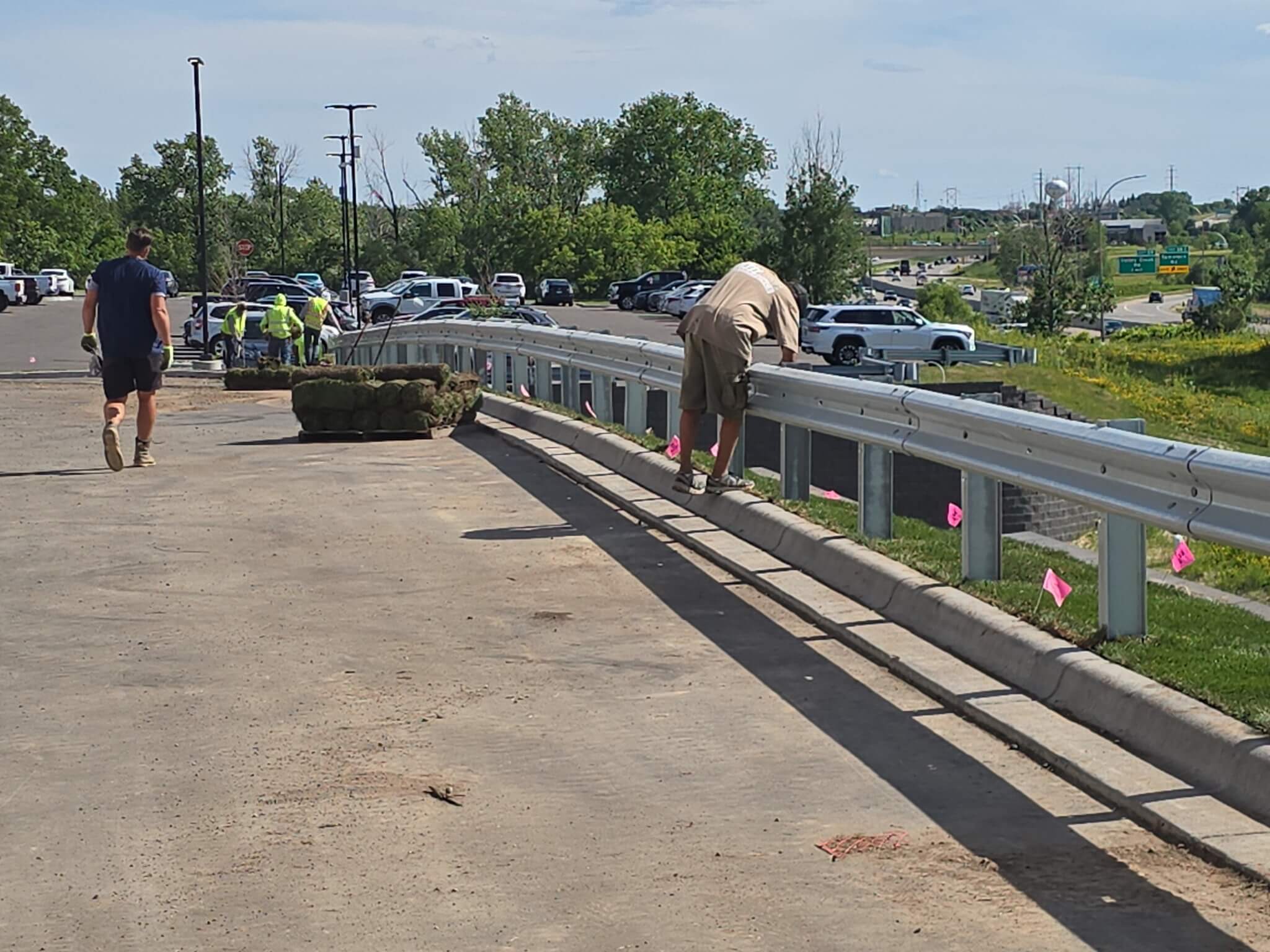
On the Ground: A Look at the Commercial Guardrail Install
- Chasing the Master Schedule: On a major commercial site, nobody works in a vacuum; you are constantly dancing around five other trades. In this shot, our installers are manually setting the beam overlaps and ratcheting down the 5/8-inch shoulder bolts right as the site’s landscaping crew rolls the fresh sod up to the curb. Getting those bolts set to the right torque is vital—it leaves just enough “play” in the metal for the steel to expand in July and shrink in January without warping.
- The Art of the Custom Curve: Fencing a straight line takes muscle; smoothly wrapping rigid, corrugated steel around a tight civil entryway takes an artist. This photo shows our custom-radius bend tracking the fresh asphalt. Notice the precise distance between the back of the curb and the posts—we measure that down to the inch so a driver’s front tire can’t strike the post beneath the rail.
- The I-94 Shield: Looking down the stretch parallel to the highway, you get a real sense of the scale of this perimeter run. Backed by deep-driven steel posts, the ends of the run are capped with flared impact terminals. If a car happens to strike the very end of the fence head-on, that specialized head crumples the steel rail out of the way safely, rather than letting the rigid beam act like a spear.
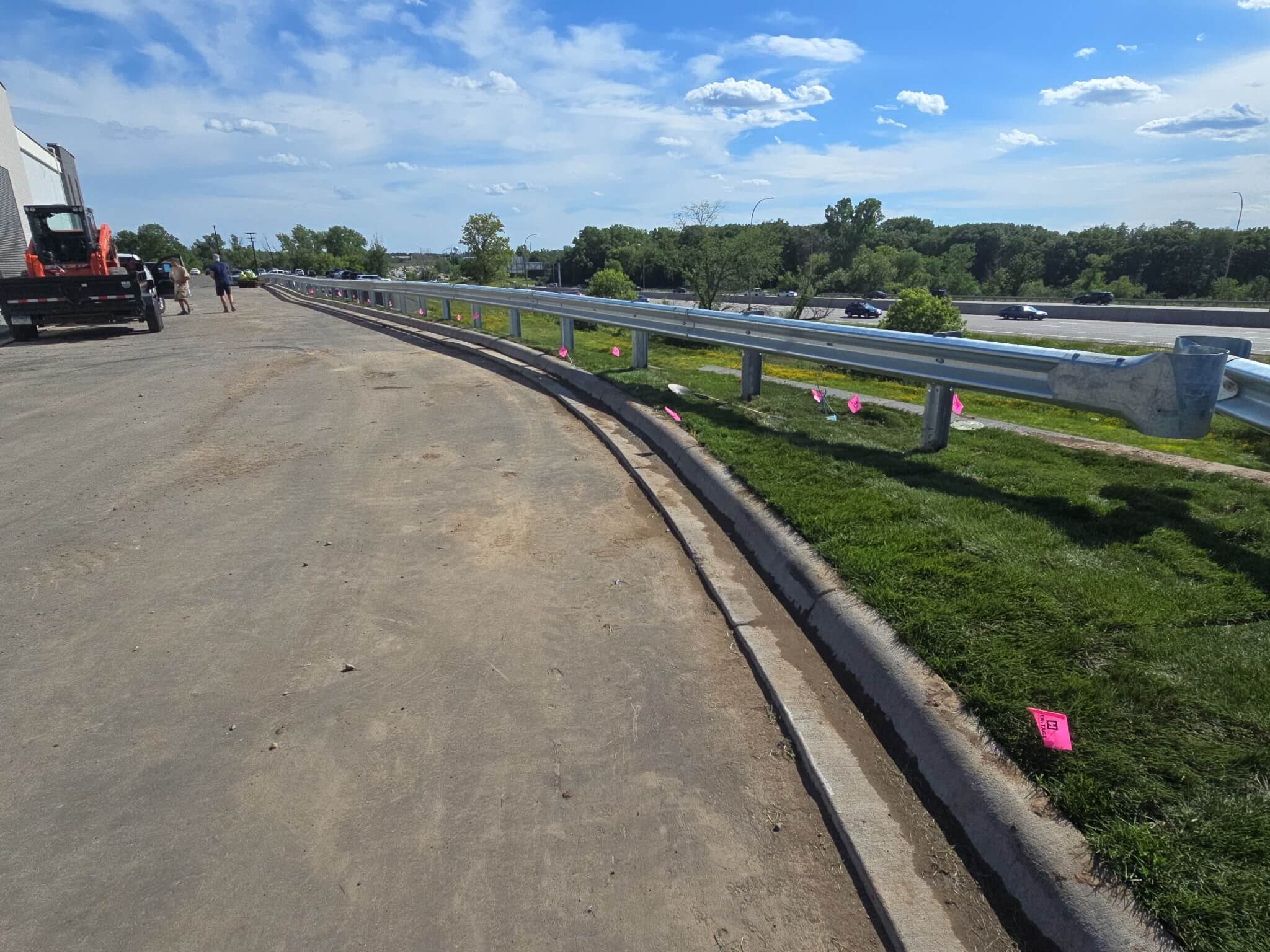
The Property Manager’s Favorite Feature: “The 45-Minute Fix”
When we sit down with commercial developers, we always tell them the same thing: Someone is eventually going to hit this fence. It’s a retail parking lot; it is a statistical guarantee. If a distracted driver backs into a poured concrete retaining wall, the venue has to tape off the area, hire a masonry crew, dowel into the slab, and pour fresh concrete—a headache that costs thousands and takes a week.
When someone backs into this W-beam, the fence did its job. The site manager simply calls our desk, two guys drive out with a wrench, unbolt the crumpled 12.5-foot section, pop a fresh galvanized panel onto the existing posts, and the venue is 100% secure again before the lunch rush even finishes.
Let’s Secure Your Next Blueprint
Whether you are breaking ground on a retail hub in Woodbury, expanding a logistics warehouse in Eagan, or trying to secure a multi-level parking deck in downtown St. Paul, standard chain-link isn’t always the answer. Sometimes, you need real, heavy-duty stopping power.
We know the local soil, we know the state DOT codes, and we own the post-pounders to get the job done right. Give Twin Cities Fence a call today to talk over your site plans and get a real, human quote on your commercial guardrail project. (612) 443-1948